Published September 10, 2026Edited September 10, 2026
12 min read
A top-30 of IPTV service providers is usually one panel sold under thirty shop names. This is the subscription review we actually run: a busy evening, the television you own, and the warning signs those lists skip.
Search results for best IPTV service providers are crowded with the same article shape: a numbered thirty, a 2026 or 2027 in the headline, and the words honest review. Most of those pages are sales pages with a list glued on. Thirty names does not mean thirty networks. It often means thirty storefronts buying access to the same upstream panel.
We sell a subscription. The homepage is the product page. The longer provider framework is how the market is structured. This page is the honest IPTV subscription review: what we check after 8pm, and why we will not invent a scored top 30. The byline is BestIPTV2027 Editorial. Treat every line as coming from the desk that also takes the order.
What a '30 best providers' list usually is
People type that query because they want a shortcut. The shortcut is usually paid. Ranked lists in this trade change hands, reuse the same screenshots, and quietly reshuffle when a sponsor pays. A name that sat at number four in March can be a dead Telegram account by September. That is why a dated evening test beats a trophy graphic.
If two shops show the same channel order, the same dead streams, and the same guide errors, you are not comparing thirty services. You are comparing thirty checkout pages. Collapse the list to three kinds of seller (reseller, mid-tier operator, someone who actually runs capacity) and the review gets shorter and more useful.
The gap that showed up after 8pm
Sales pages compete on catalogue size. Evening viewing does not. When we sit with a US connection and flip through the same kind of lineup people actually watch (national news, a couple of entertainment channels, a live game), the cheap lines and the mid-range lines do not behave like neighbours. They behave like different products.
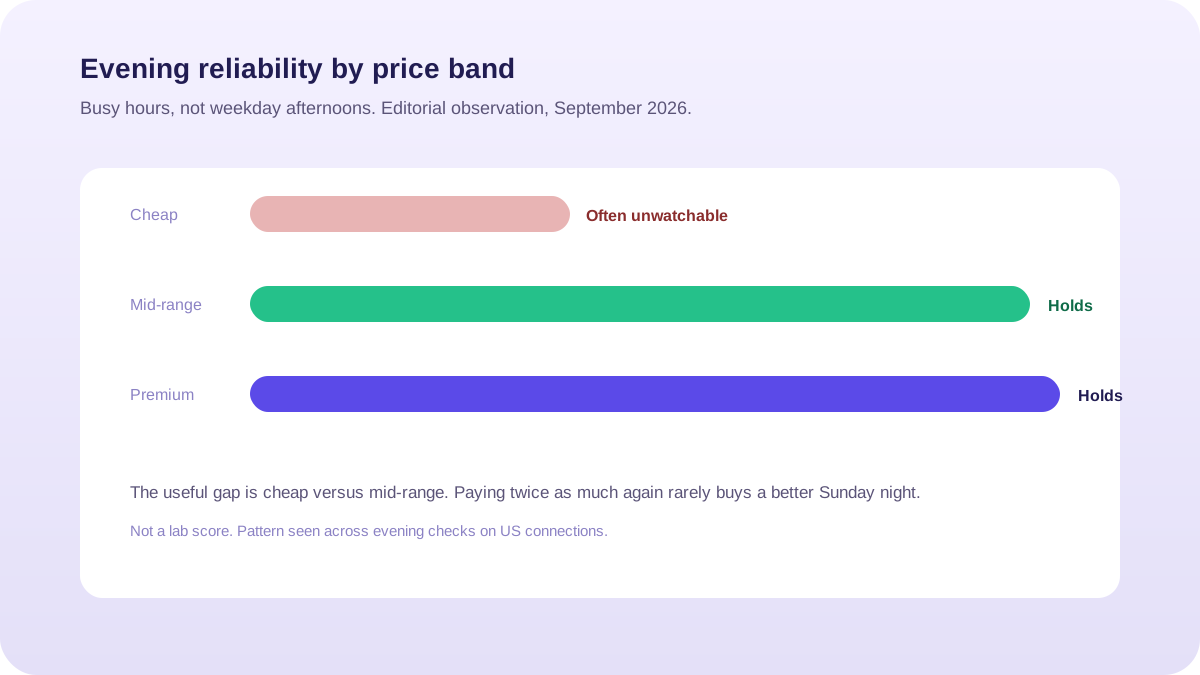
Under about $5 a month, feeds that looked fine at lunch regularly stalled once the house filled up. Picture dropped to 720p or lower. Some channels that were listed simply never opened. In the $8 to $15 band the same evening usually held. Above $20 the picture was not dramatically cleaner. Paying twice as much again bought a nicer website more often than it bought a better Sunday night.
That is an editorial pattern, not a laboratory scorecard. We do not publish invented star ratings and we do not pretend to have audited fifteen unnamed vendors in a sealed room. The useful finding is simpler: the painful drop is between bargain-basement and competent mid-range. The expensive tier is a smaller step than the marketing implies.
Price band
What evenings usually looked like
Under $5 / month
Frequent stalls on live sport; many listed channels missing or stuck at 720p
$8 to $15 / month
Most of the lineup held through a busy night, including national games
Above $20 / month
Similar stability to mid-range; the extra money rarely showed on the screen
Our own one-screen month is $14 as of September 2026, which sits inside that middle band on purpose. The twelve-month plan is $69, about $5.75 a month if you divide it out, but that is prepaid risk rather than a cheap monthly. The full matrix lists every screen count. The provider evaluation guide is the longer framework if you want to point the same checks at somebody else.
Live sport is the only honest load test
A weekday afternoon tells you almost nothing. A packed Sunday night does. Pro football, basketball and combat sports all pull a large share of a subscriber base onto one feed at the same second. That is when a service sized for average demand starts to show it.
If you only remember one habit from this article, make it this: do not judge a trial at noon. Load the channel you actually care about, on the television in the living room, during a fixture other people also want. The sports page explains why some games are missing for rights reasons rather than capacity. Those two problems get confused constantly, and they need different answers.
Channel count is a sales number
We counted 61,000 live channels on 1 August 2026, one entry per channel, only where the feed played. That date is on the channels page because an undated total cannot be checked against anything. Plenty of sellers advertise much larger libraries. The extra digits are usually duplicates, regional variants, offline backups, and the same channel listed at three resolutions.
A smaller, maintained lineup beats a padded one. During busy evenings the weaker services we tried delivered roughly half to two-thirds of a sample of eighty channels in a usable state. The stronger ones kept almost all of that sample open, with a lot of it in 1080p and a thinner slice above that. We would rather have ten thousand streams that still exist next month than a homepage that says one hundred thousand.
The useful gap is cheap versus mid-range. The expensive tier is a smaller step than the price difference suggests.
The device you already own is part of the product
A subscription that forces a new box into the house is a worse deal than the monthly figure admits. Compatibility is not one switch. It is the player, the firmware, and the way that particular television talks to the network.
People searching for IPTV Smart TV USA usually hit this first. Samsung and LG do not install the same way. Android TV and Google TV are closer to a phone than to either of those. A stick sitting on HDMI is often the calmer path, which is why the Firestick guide and the smart TV guide exist as separate pages.
Amazon Fire TV Stick and Fire TV devices
Apple TV
Android TV and Google TV boxes
Samsung and LG smart televisions
Android phones and tablets
iPhone and iPad
Windows PCs and Macs
Check the exact model before you buy a year. A 24-hour trial on the living-room screen answers this faster than any compatibility badge. The rest of the setup index covers phones, desktop players and MAG-style boxes.
Why US viewers keep leaving cable
Cost is still the first reason people write in. After that comes a wider mix of channels, including international feeds a US cable bundle never bothered to carry. A smaller group is simply tired of a twelve-month contract they cannot leave without a fee. We do not have a surveyed percentage for those motives and we will not invent one.
Saving money is not useful if you spend Sunday restarting an app. The cable bill breakdown shows how an $80 advert becomes $110 to $135 once the extra lines land. The IPTV versus cable page is the product comparison. Neither page is a reason to ignore the evening test.
Warning signs that keep repeating
No way to try the service on your own line
Performance depends on your internet provider, your city, the player, the wireless situation in the room, and how busy the seller's servers are that night. A short trial is the only way those variables get tested together. We run a 24-hour trial with no card for that reason. A seller who will only sell you a year, sight unseen, is asking you to take their word for a product that changes by the hour.
A price that cannot pay for the servers
Three or four dollars a month looks kind until you ask where the capacity comes from. Streaming costs money. When the entire offer is the lowest number on a comparison table, something else is being cut: headroom on busy nights, someone answering messages, or the work of keeping channels alive. The reliability gap between those lines and a maintained mid-range service is the one we keep seeing.
A channel number that could not possibly be maintained
Huge totals look decisive on a homepage. They are cheap to print. Judge the service by the channels that open at 8pm, not by the biggest integer the designer could fit under the logo.
A checkout you cannot explain to yourself
Before you pay, you should be able to say who you are paying, what term you are buying, whether anything renews, and what the refund window is. Ours is seven days and is written on the refund page. Do not send money through a method you do not understand because a seller told you it was faster.
A guide that is decorative
The electronic programme guide is easy to ignore until you live with the service. Wrong times, blank slots, or a guide that never loads turn a large lineup into a guessing game. If the listings are a mess on day one, they are not going to become a product later.
Support that exists only before the payment
Follower counts are not a helpdesk. Look for a channel you can actually reach after something breaks. Our only support line is Telegram at @ProAssist24, which we state on every page so nobody has to hunt for a chat widget that is not there. A polished site with nobody behind it after checkout is a very common way to lose a year of money.
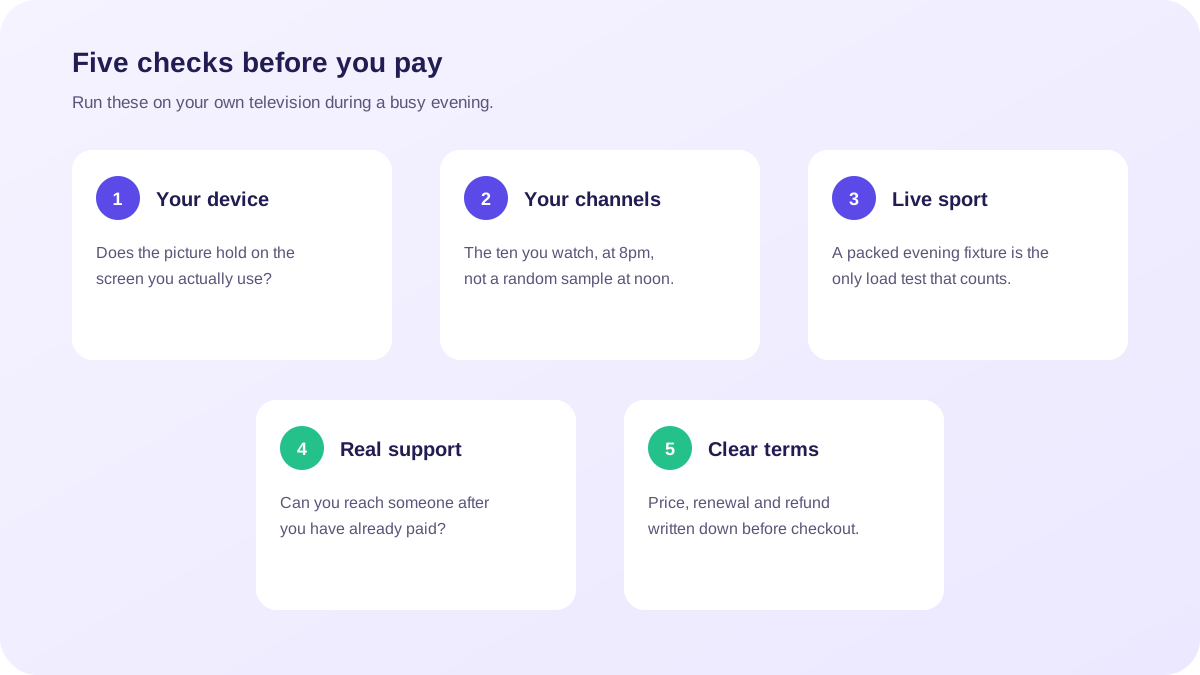
If a homepage cannot survive these five questions, the channel count will not save it.
Signals that a trial is worth starting
None of these guarantee a perfect picture. Together they mean you are not walking in blind.
A trial, or some other way to test on your own hardware
Prices you can read without opening a chat
A support channel that answers before you pay, with a name you can find again
Setup notes for the devices people actually own
A guide that loads and shows roughly the right programmes
Published terms, including refund and renewal language
More than one player format (M3U, Xtream, MAG portal)
A checkout that names the seller
Claims about quality that stay this side of physically impossible
Nobody can sell you a service that never buffers
No buffering IPTV is a search phrase with a lot of advertising behind it. Treat a promise of literally zero stalls as marketing. Too much of the path sits outside the seller's building: your speed, the wireless in the room, how your internet provider routes the traffic, a VPN if you use one, the age of the stick, the player, the load on their servers, and whether half the country is watching the same game.
A realistic goal is a service that stays watchable on a normal evening and still has headroom when a big fixture lands. If the picture does stall, the buffering diagnostic separates your network from their feed. We recommend about 10 Mbps per screen. That is a floor, not a personality trait of the subscription.
The middle band keeps winning the value argument
Spend more than $20 a month if you want to. Just do not expect the screen to transform. The mid-range lines we used on busy US evenings were close enough to the expensive ones that the extra invoice was hard to justify. The cheap lines were not close to either.
For a lot of households the honest answer sits between a $4 gamble and a $25 badge. That is also where we priced the one-month plan. If you already know you will stay, the annual number is on the pricing page. If you do not know yet, a month is the adult purchase.
Five questions before you buy anything in 2026
1Does it work on the device already plugged into the television?
2Are the channels you personally watch stable after 8pm?
3Does a live game still look acceptable when the rest of the country is watching too?
4Can you reach support after something breaks?
5Are the price, the term, and the refund written down in language you understand?
Those five beat a homepage that says 50,000 channels or 100 percent uptime. Uptime figures on this site are operator claims, not an audit we commissioned.
How to use an IPTV subscription review
The best IPTV service providers, for an actual household, are the ones whose picture still holds on that household's television during the hours they care about. A numbered thirty is a weak proxy for that. So is a low sticker price. So is a 2027 in the headline.
The legality question sits on its own page because it is not a pricing question: is IPTV legal walks through the technology versus the rights. Read that before you cancel a cable contract you still want a way back into.
Related questions
What should a stable IPTV service cost in the USA in 2026?
Lines under $5 a month usually showed the worst evening failures in our checks. The $8 to $15 band was the one that held. Our one-screen month is $14 as of September 2026; the year is $69. Paying more than $20 rarely bought a clearly better picture.
Can I run IPTV on a Samsung or LG TV in the US without a stick?
Sometimes. The store and the sideload path differ by brand and by year of the set. If the built-in apps fight you, a Fire TV Stick on HDMI is the calmer install. Test the living-room screen during the trial rather than assuming the badge on the box is enough.
Why do cheap IPTV apps freeze on Sunday nights?
Because that is when a large share of subscribers hit the same live feed. A service sized for quiet afternoons runs out of headroom. The channel often opens, then falls apart once the game is underway. That is a capacity problem, not a mysterious curse on weekends.
Is a 24-hour IPTV trial long enough to judge sports quality?
Yes, if you use it during a busy fixture on the television you will actually watch. A quiet weekday afternoon will flatter almost any seller. Our trial is 24 hours and does not take a card.
Are the '30 best IPTV service providers' reviews honest?
Usually not. Many are paid placements or thirty storefronts on the same panel. An honest IPTV subscription review names who wrote it, what was tested, and when. Ours is this desk, evening checks, September 2026. We do not publish a scored top 30 we never ran.