IPTV Service Provider: How to Choose One That Lasts
· 26 min read
Most guides rank providers. This one hands you the framework they used, so you can judge any IPTV service provider yourself — including us.
· 26 min read
Most guides rank providers. This one hands you the framework they used, so you can judge any IPTV service provider yourself — including us.
Choosing an IPTV service provider is difficult for a reason that has nothing to do with technology. The product is genuinely hard to inspect before you buy. You cannot walk into a shop and watch a channel list at eight o'clock on a Saturday evening, which is the only moment that really tells you anything. So people fall back on the things they can see — a channel count, a price, a review page — and every one of those is trivially easy for a seller to manufacture.
This guide does not rank providers. Ranked lists in this industry are almost always paid placements, including the ones that look editorial, and a list that was accurate in March is misleading by September because the underlying services change hands constantly. What follows is the evaluation framework instead: what an IPTV service provider actually sells, how the market is structured, which claims carry information and which are noise, and a sequence of checks you can run inside a trial window. Point it at us if you like. The framework does not care who it is applied to.
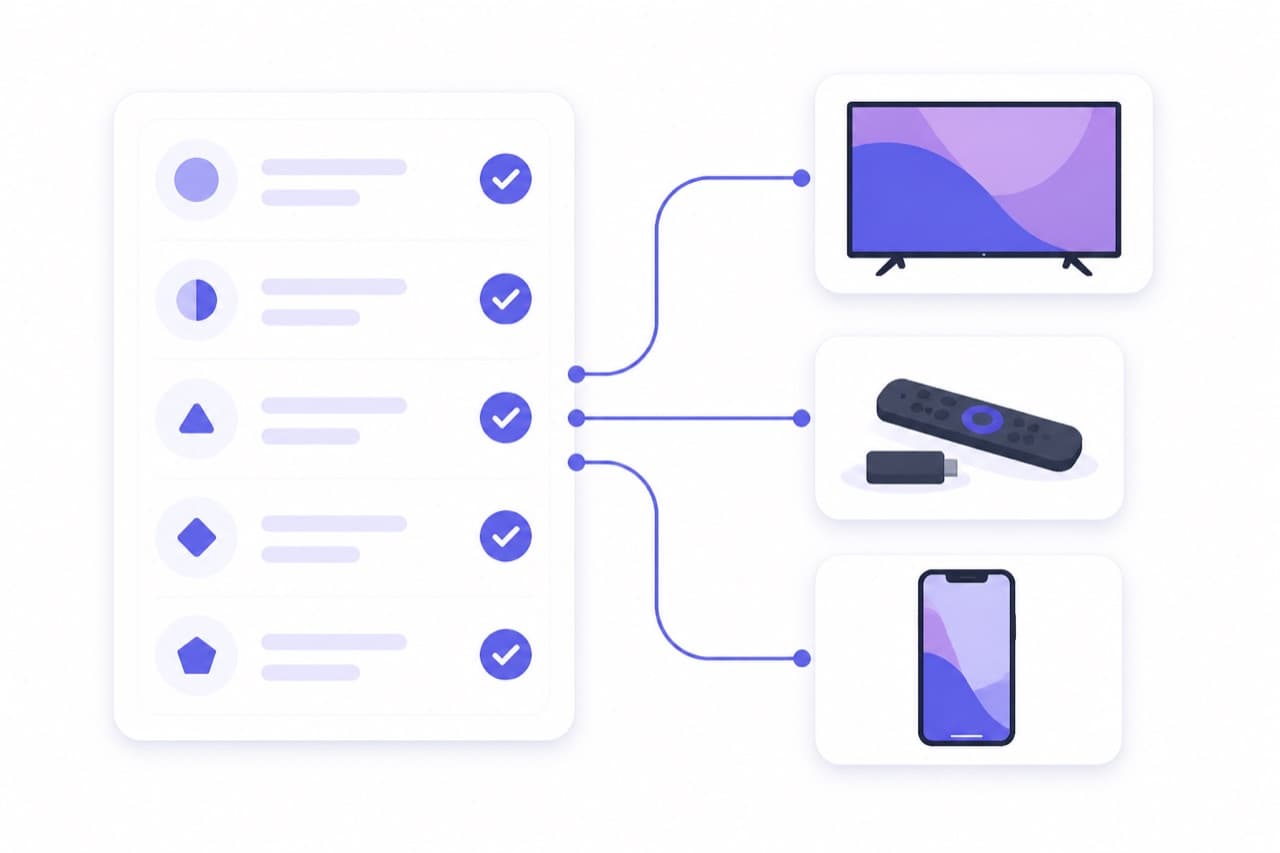
This is worth being precise about, because the misunderstanding at the root of most disappointment is structural rather than technical. When you subscribe, you are not buying software, you are not buying a device, and you are not buying content in the way an on-demand streaming subscription buys content. You are buying access to a server that restreams television feeds, plus a set of credentials that authorises your household against it.
Practically, that means three things arrive: a server address, a username and a password. Sometimes the same access is expressed as a single long M3U URL instead — the difference between M3U and Xtream credentials matters when you set up, but not commercially. You supply everything else. The app you watch in is a free third-party player. The hardware is whatever you already own. If you have never used a service like this, the plain-English explanation of how IPTV works is the better starting point, and Wikipedia's overview of IPTV as a delivery method covers the underlying technology without a sales pitch attached.
Two consequences follow, and they shape the whole evaluation. First, no IPTV service provider can lock you in through hardware or software, because it supplies neither — switching costs you the twenty minutes it takes to paste new credentials into the same app. Second, the only thing a provider genuinely controls is server capacity, feed sourcing and support. Those are exactly the three things you cannot see from a sales page, which is why the rest of this guide is about inferring them from evidence you can actually gather.
Almost every site you will find in a search belongs to one of three layers, and they are not competitors in any meaningful sense — they are a supply chain. Understanding which layer you are talking to explains more about your likely experience than any feature list, because it determines who can actually fix a problem when one occurs.
| Tier | What it is | What it means for you |
|---|---|---|
| Reseller | Buys credit in bulk from a panel and resells it. No servers, no feeds, often one person. | Cheapest, most numerous, least durable. Cannot fix an outage — only relay it upstream. |
| Mid-tier operator | Runs its own front end and support, leases server capacity, sources some feeds directly. | The realistic middle. Can fix routing and capacity issues, depends upstream for some feeds. |
| Upstream panel | Owns the infrastructure and sources feeds. Usually sells to resellers, not to the public. | Rarely reachable directly. When it is, support is thin because you are not its customer. |
The great majority of sites advertising themselves as the best IPTV provider are resellers, and that is not automatically a problem. A competent reseller with a good upstream and fast replies can be a perfectly good experience, often at the lowest price available. What it does mean is that their guarantees are only as good as an arrangement you cannot see. When the upstream has a bad evening, your reseller finds out when you tell them, and can do nothing but pass it along and wait.
You can usually place a seller within a few minutes. Resellers tend to have no company details anywhere on the site, a support channel that is a single personal messaging account, prices noticeably below the field, and a channel count copied verbatim from other sites. Operators tend to publish something checkable — a registered entity, a dated catalogue, a stated connection limit, a refund policy with a number in it — because those are commitments a one-person reseller cannot safely make.
Turnover in this market is very high, and understanding why makes the warning signs obvious rather than mysterious. Three forces do most of the damage.
The first is that annual subscriptions collected up front create an obvious temptation. A reseller who sells hard for two months on twelve-month plans has a year of revenue in hand and a year of obligations to service. Closing and reopening under a new name is, in the short term, more profitable than honouring the second half of those subscriptions. This is the single most common way people lose money here, and it is why the length of plan you buy is a risk decision rather than just a discount decision.
The second is that upstream panels get taken down. Enforcement action against a large panel takes every reseller downstream with it, all at once, regardless of how honest any of them were. A reseller with a single upstream has no recovery path from this; a mid-tier operator with more than one source has a partial one.
The third is simple undercapitalisation. Serving live video at peak concurrency is genuinely expensive, and a provider who won the customer on price cannot afford the capacity that keeps them. Quality decays through the second half of a subscription, complaints rise, and the operation folds or quietly stops answering.
Channel counts are the headline number in this industry and the least informative one. They are unverifiable, unaudited, and inflated by a set of standard techniques that are worth knowing because once you can see them, the numbers stop being persuasive.
| Inflation method | How it works | Real effect on you |
|---|---|---|
| Quality duplicates | One channel listed at 4K, FHD, HD and SD as four entries. | Multiplies the count by three or four. No new content. |
| Dead entries never pruned | Feeds that stopped working are left in the list. | Inflates the count and makes browsing worse. |
| Event placeholders | Hundreds of numbered slots for occasional fixtures. | Empty most of the time, counted always. |
| Radio and test feeds | Audio stations and colour bars counted as channels. | Pure padding. |
| Region-locked entries | Counted for everyone, playable in one country. | Unwatchable for most subscribers. |
Apply that to a claimed 100,000 channels and you can usually deflate it by an order of magnitude before you reach anything a household would actually watch. Which is the real point: the number that matters is not how many channels exist, it is whether the fifteen or twenty you personally care about are present, stable and in the resolution you were promised. A provider with 8,000 well-maintained channels including all of yours beats one advertising 120,000 that stutters on the one you watch every week.
So invert the process. Write down your list before you look at any provider — the channels you would notice losing, the leagues you follow, the languages your household needs. Then check that list against a trial. It converts an unfalsifiable marketing number into a test you can actually run and pass or fail. Our own figures, for what it is worth, are dated for exactly this reason: 61,000 live channels and 180,000 on-demand titles counted on 1 August 2026, with 2,400 in 4K across 42 languages. A dated number can be checked and can be wrong. An undated one is unfalsifiable, which is the whole appeal of publishing it that way. You can browse the full channel list rather than take the figure on trust.
Most people test a new provider badly, and the reason is understandable: they test it when they have time, which is a weekday afternoon when every server on earth looks excellent. Capacity problems only appear under load. A test that avoids peak hours tells you almost nothing about how the service will behave when you actually want to use it.
Run these in order. The sequence matters, because each step rules out a class of problem before you spend time on the next one.
One diagnostic is worth building into the process from the start, because it settles the argument you will otherwise have with support. If a stream stutters, open the same channel on a laptop on the same network. Clean on the laptop means your television or streaming stick is the bottleneck, not the provider. Stuttering in both places points at your connection or their server. That single test resolves most disputes before they start, and the full buffering diagnostic works through the rest in order. A broadband speed test at the same time of evening establishes whether your own line is the variable.
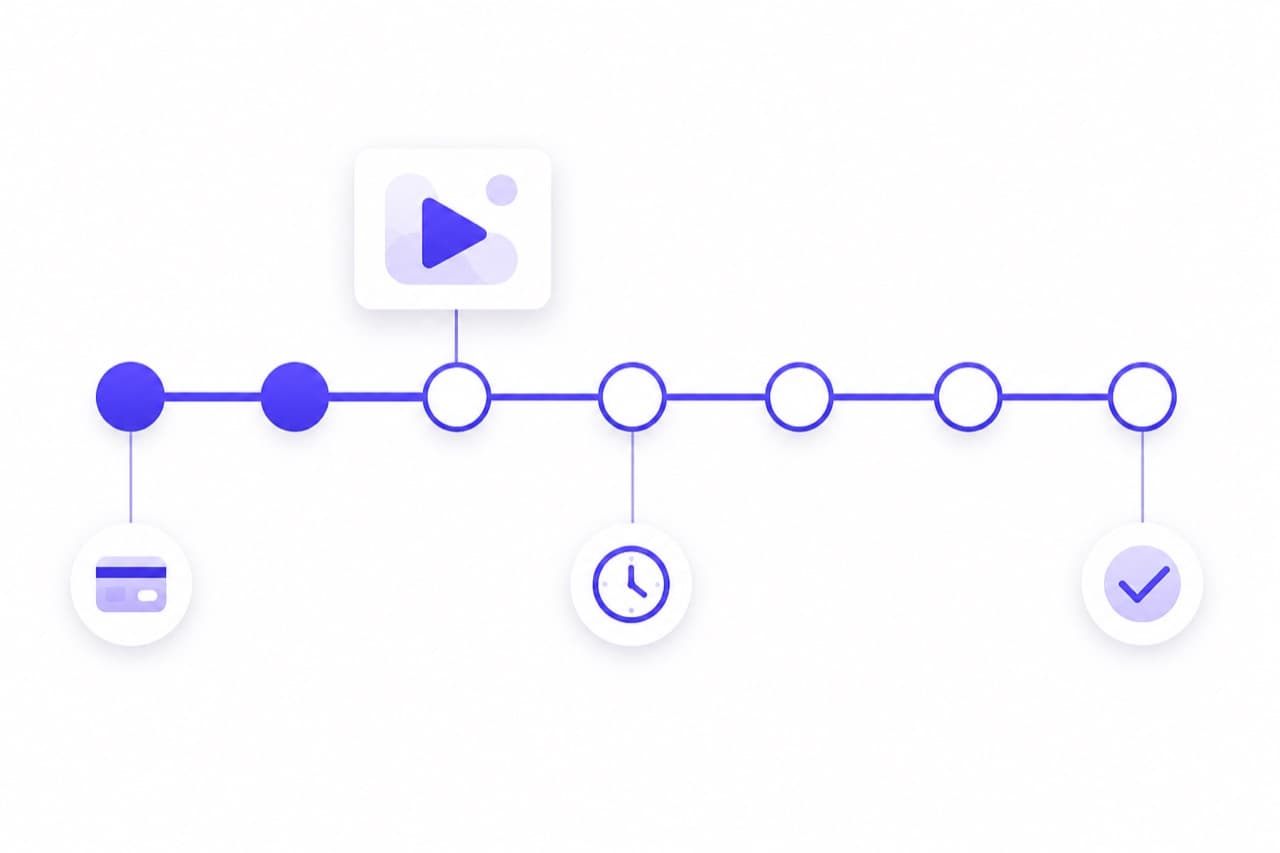
Any provider unwilling to let you see the product before you pay is telling you something, and a trial costs them almost nothing to offer. Its absence is a meaningful signal. But trials are also easy to game, so it is worth knowing what a given trial can and cannot establish.
Trial credentials are sometimes issued on separate, lightly-loaded servers, which means an excellent trial does not fully guarantee an excellent paid experience. You cannot detect this directly. What you can do is weight your trial towards peak hours, so that if they are giving you a quiet server you at least find out how their quiet server behaves under real demand. If the trial itself struggles at 8pm, that is conclusive and you can stop there.
Trial length shapes what you can learn. A couple of hours tests whether the credentials work. Twenty-four hours, used deliberately, covers one evening peak and gets you a support reply. A week covers a full weekend of sport, which is the real stress test. Ours is a 24-hour trial with no card required, and the honest framing is that it is enough for one properly-run evening rather than a leisurely fortnight — which is why the checklist above is ordered the way it is.
Treat a refund policy as the second half of the same question. A stated window with a number in it — ours is seven days — is a commitment that can be held against a provider. Vague language about satisfaction is not, and a policy that excludes the reasons people actually ask for refunds is worse than no policy at all, because it is designed to look like protection while providing none.
How a provider takes money is one of the most informative signals available, because it reveals their relationship with the payment industry and how much recourse you retain if things go wrong. It is also one of the few things on a sales page that cannot be fabricated.
| Method | Your recourse | What it signals |
|---|---|---|
| Card via a mainstream processor | Strong. Chargeback rights apply. | Passed a processor's compliance review. Hardest to obtain. |
| PayPal | Moderate. Dispute process exists. | Some vetting. Accounts in this sector are often short-lived. |
| Cryptocurrency | None. Irreversible. | Common and not damning, but it shifts all risk to you. |
| Gift cards or vouchers | None whatsoever. | Treat as a hard stop. No legitimate reason to prefer this. |
| Direct bank transfer to a personal account | Effectively none. | Hard stop. You are paying an individual, not a business. |
Crypto-only pricing deserves a note, because it is genuinely ambiguous rather than simply bad. Plenty of competent operators accept crypto because mainstream processors are reluctant to serve this sector at all, so its presence is not evidence of dishonesty. What matters is whether it is the only option. A provider offering card or PayPal alongside crypto has cleared a compliance bar and given you a dispute path. A provider who will accept nothing reversible has arranged things so that a bad outcome is entirely your problem, and the size of the discount they offer for it is not adequate compensation.
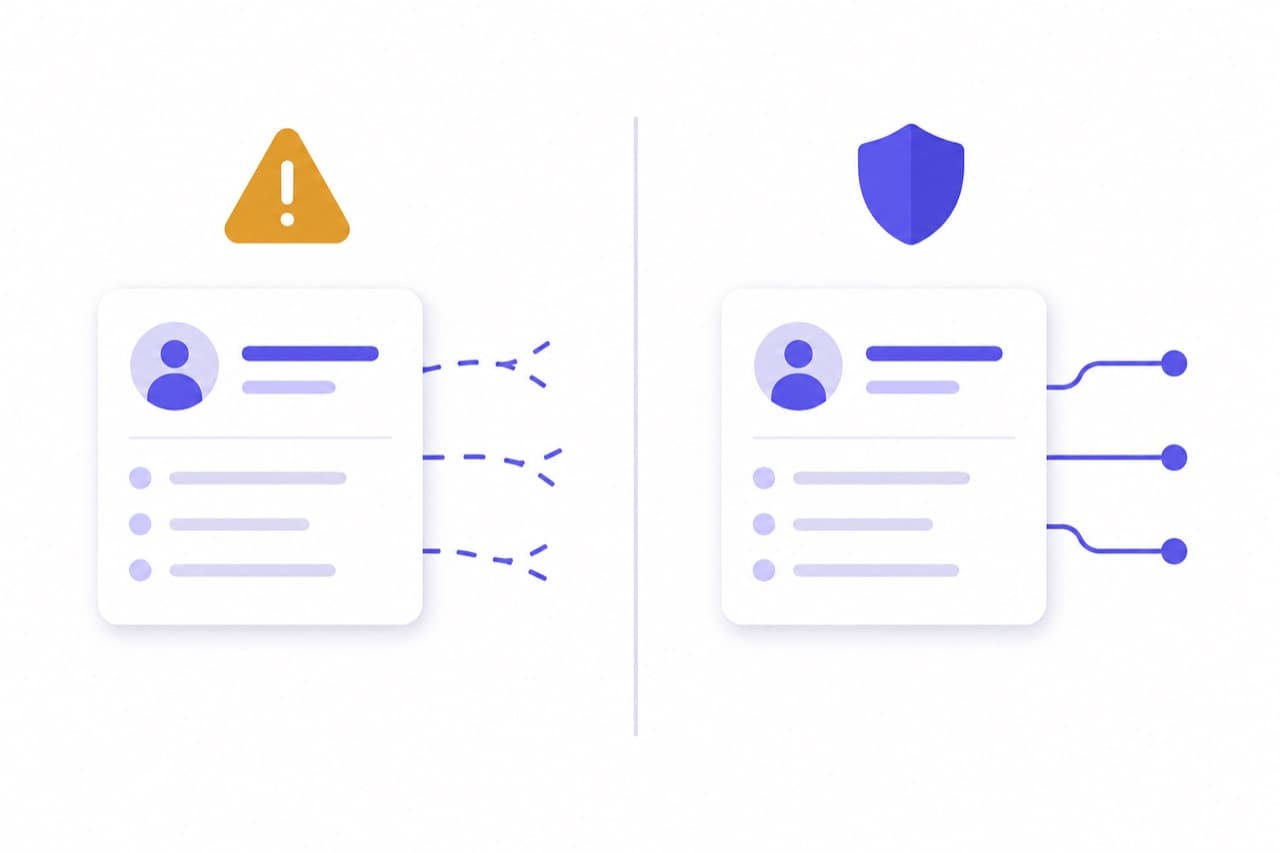
Individually, several of these have innocent explanations. The pattern is what matters: any single item might be a small operation cutting corners on its website, but three or four together describe a specific kind of IPTV service provider, and it is not one you want a twelve-month relationship with.
One inversion is worth applying to any provider, us included: look for claims that could be proven wrong. A dated channel count, a named connection limit, a refund window with a number, a published price in your own currency. These are commitments, and a business willing to make falsifiable claims is behaving differently from one that deals only in superlatives. It is a much better signal than any amount of confident language about being the best IPTV provider available.
The connection limit is how many devices can stream simultaneously on one subscription, and it is quietly one of the most consequential numbers in the whole decision — because when you exceed it, the failure does not announce itself. A stream simply stops, or refuses to start, usually at the worst possible moment. Nothing on screen mentions the limit, so people reasonably conclude the service is broken.
Count your household honestly before choosing a plan. A living room television, a bedroom set, a tablet in the kitchen and two phones is five potential connections, and it is entirely normal for four of them to be active on a Sunday afternoon. A single-connection plan in that house will generate weekly arguments. Ours allows five, which covers most households without anyone having to negotiate.
Two details are worth knowing because they cause confusing symptoms. First, a device left paused or backgrounded often still holds its connection, so the count can be higher than the number of people watching. Second, some providers count a channel change as a brief second connection, which means rapid zapping on a maxed-out plan produces failures that look random. If streams start failing for no apparent reason, count the signed-in devices before reporting a fault — it is the most common false alarm in support queues.
Everything an IPTV service provider says about its infrastructure reduces to one question: what happens when everyone wants the same feed at the same time? A service that is flawless at three in the afternoon and unwatchable during a major midweek football match is not a good service with an occasional problem. It is an oversold service, and the afternoon performance is irrelevant to how you will actually use it.
Overselling is the standard economic failure here. Capacity is sized for average concurrency rather than peak, because average is far cheaper, and the model works right up until a major fixture when a large fraction of subscribers converge on one stream. The symptoms are specific enough to recognise: fine all week and unwatchable during the derby, channel changes that take five seconds or more, and quality that visibly steps down as an evening progresses.
Geography matters as well, and simple physics puts a floor under it. Every additional network hop between the server and your house adds latency and another opportunity for congestion. A provider with servers near you will generally outperform a technically superior one on another continent. This is why a service can be genuinely excellent for subscribers in one country and mediocre in the next, and why reviews from another market are weak evidence about your own. If a provider cannot tell you which region serves you, they either do not know or would rather not say.
Your own connection has a floor too, and it is lower than most people assume: roughly 25 Mbps sustained for comfortable 4K, 10 Mbps for 1080p, and stability matters more than headline speed. A 500 Mbps line that dips every few minutes is worse than a rock-solid 50 Mbps one. If you are on wireless and the stutter arrives in the evening, the single highest-yield fix is an Ethernet cable — it removes the variable that causes most complaints wrongly attributed to providers.
If you want one quick proxy for how much care an IPTV service provider puts into work that nobody advertises, open the programme guide. Channel feeds can be acquired wholesale. A correct, deep, properly time-zoned EPG has to be maintained, and it is invisible in every screenshot on every sales page, so it is precisely the thing a careless operation skips.
Check three things. Depth: does it extend a week ahead, or twelve hours? Accuracy: do the programme names match what is actually playing, particularly on channels from other countries? Time zones: are entries shifted by an hour or several, which is common and reveals that nobody localised the data. A guide failing all three on a service claiming tens of thousands of channels tells you where the effort went.
Catch-up is the same story a level deeper. Advertised nearly universally, genuinely working far less often, because it requires the provider to record and store output continuously rather than just pass a live feed through. Test it on a specific programme from two days ago rather than accepting that the feature exists. Worth knowing too that the player shares responsibility here: a guide that looks broken in one app is sometimes fine in another, which is why the player comparison is worth reading before blaming a provider.
You will need support at some point — a device change, a password reset, a channel that has moved, a renewal problem. The quality of that interaction is difficult to assess in advance and disproportionately determines whether you stay, so it is worth spending part of a trial on deliberately.
Send a question specific enough that a canned reply cannot cover it. Ask which server region serves your city, or whether a named channel is available in 4K on your plan. You are measuring three things at once: how long the reply takes, whether it actually addresses what you asked, and whether the answer is technically coherent. A response in under an hour that engages with the specifics is a good sign. A three-word answer, or a link to a generic FAQ, tells you what month seven will feel like.
Channel matters as well. A support system tied to one personal messaging account is one person's availability, and it disappears when they sleep, travel or lose interest. Multiple channels with stated hours indicate an operation built to outlast one individual's enthusiasm. Neither guarantees quality, but the second is a structural signal and the first is a structural risk.
This deserves a straight answer rather than the evasion most sites offer. The technology is entirely legal: IPTV is a delivery method, and mainstream broadcasters and telecoms companies use it themselves. What determines legality is whether the service holds distribution rights for the content it is retransmitting in your territory.
Most low-cost services offering large multi-country channel packages do not hold those rights, and the honest position is that this is a legal grey area which varies considerably by country. Enforcement in most jurisdictions has focused on operators and large-scale distributors rather than individual subscribers, but that is a description of current enforcement priorities rather than a guarantee about your position, and it is not legal advice. Regulators publish their own guidance: Ofcom covers the UK, and the EU Intellectual Property Office publishes research on illegal streaming across member states.
Two practical risks are more immediate than the legal one. Sideloaded applications from unvetted sources are a genuine malware vector — the UK National Cyber Security Centre's guidance on app sources applies directly here, and it is a strong argument for installing only well-known players from official stores. And a provider making confident claims about being fully licensed while declining to name a single licensor is misrepresenting its position, which is a reason to doubt everything else it tells you. Our fuller treatment is on the IPTV legality page.
Price is the easiest thing to compare and the easiest to be misled by, because the meaningful figure is not the monthly rate but the monthly rate multiplied by the risk that the service stops existing before the term ends.
| Monthly equivalent | What it usually indicates |
|---|---|
| Under $3 | Below the cost of serving peak video. Either heavily oversold or a short-lived reseller. |
| $4 to $8 | The realistic band for a competent service bought on a longer term. |
| $10 to $15 | Normal for a one-month plan. You are paying for flexibility, which is often worth it. |
| Above $20 | Either a premium niche offering or ordinary service with good marketing. |
The counterintuitive advice is to avoid the cheapest tier specifically. A very low price is not generosity, it is a signal about capacity, and the saving evaporates the first time a match is unwatchable. The best IPTV provider for you is rarely the cheapest one on the page: it is worth paying a little more for an operation that can afford its servers, and worth paying the short-term premium initially so that a bad outcome costs one month rather than one year.
Set the comparison against what you are replacing rather than against other IPTV providers, since that is the decision you are actually making. A typical cable or satellite package with sports runs several times these figures once equipment rental, regional fees and the post-promotional rate are included, and the line-by-line cost comparison shows the arithmetic with every fee counted. Our own plans, in your currency and with no fees added at checkout, are on the pricing page.
Weighting matters here, because these factors are not equally predictive. Peak-hour performance and the presence of your own channels together decide most of your satisfaction; the rest modifies it. Score any provider out of a hundred and compare candidates on the total rather than on whichever single feature their sales page emphasises.
| Factor | Weight | What full marks looks like |
|---|---|---|
| Peak-hour stability | 25 | Two evenings and a live fixture with no visible degradation |
| Your specific channels | 20 | Every channel on your own list present, in the promised resolution |
| Support responsiveness | 15 | A specific question answered coherently within an hour |
| Payment and refund terms | 15 | A reversible payment method and a refund window with a number in it |
| Guide and catch-up | 10 | A week of accurate, correctly time-zoned data; catch-up that works |
| Connection limit | 10 | Stated openly and enough for your household |
| Falsifiable claims | 5 | Dated catalogue figures, named limits, published prices |
Anything scoring below about sixty is not worth a long commitment regardless of price. Between sixty and eighty is a reasonable service worth a monthly plan. Above eighty is worth committing to a longer term for the discount. The point of scoring rather than intuiting is that it stops a single impressive number — usually the channel count — from dominating a decision it should barely influence.
Because you own neither the app nor the hardware, switching is far easier than most people expect, and knowing that changes how much risk any single choice carries. There is no contract to exit, no equipment to return, and nothing to uninstall.
If the new service needs setting up on unfamiliar hardware, the device setup guides cover each platform, including the two that behave differently from everything else: Firestick, where a permission toggle moves between software versions, and MAG-style boxes, which want a single portal address rather than a username and password.
Ignore channel counts and bring your own list. Buy the shortest plan first and extend only after a peak weekend. Test between seven and ten in the evening, because nothing learned at three in the afternoon predicts anything. Pay with something reversible. Treat a required branded app, a lifetime plan or an unstated connection limit as reasons to keep looking. Ask one specific question of support before you commit and read the answer carefully.
None of this requires trusting a review site, including this one. It requires spending one properly-chosen evening running checks that a good IPTV service provider will pass and a bad one cannot fake. That is a better use of an hour than reading any ranked list, and it stays valid long after the rankings have gone stale.